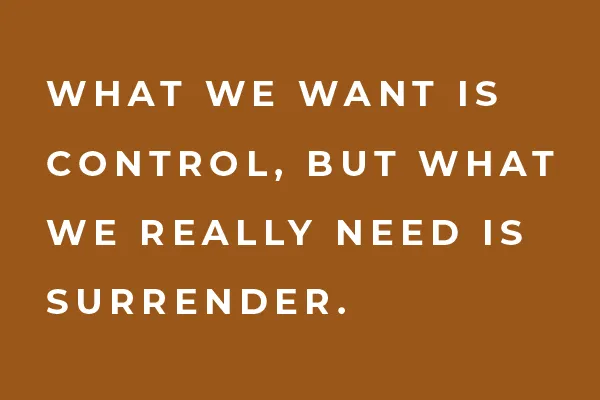
Control vs Surrender: Psychedelics and Beyond, Building Self-Trust to Let Go
Even though surrender is one of the hardest things people bring to therapy, many don’t even realize they’re doing it — or that they’re struggling with it. Clients often come in complaining about anxiety, relationship friction, or a constant need to “fix” things, and only later recognize that beneath those complaints is a repeated effort to control outcomes, feelings, and other people. We build our lives and identities around predictability and mastery — and then we feel shocked, disappointed, and unsafe when life proves otherwise. That drive to control shows up everywhere: in relationships, work, parenting, and even in how we approach inner healing. The good news is that surrender is a skill you can practice, and the doorway to it is often a quieter thing called self-trust.
Surrender doesn’t mean defeat. It means tolerating uncertainty, staying present with discomfort, and choosing responses rather than reacting from emotion, such as fear. But surrender is hard; it asks us to give up an illusion that has felt protective for years: the belief that if we manage every variable, we can prevent pain. However, that illusion never truly protects us from pain — it only robs us of the fullness of life. Control may feel like safety, but it comes at the cost of joy, connection, and the peace that comes from allowing ourselves to simply be where we are.
Control in daily life
Control is useful. It helps us meet deadlines, protect loved ones, and create a predictable life. Problems arise when control becomes the first and only response to stress. It shows up as:
Excessive checking, planning, and micromanaging to avoid unpredictability.
Avoiding deep conversations because they feel risky.
Perfectionism and all-or-nothing thinking make ordinary setbacks feel catastrophic.
Reluctance to delegate or ask others for help for fear that things “won’t be done right.”
Psychedelic and ketamine journeys test surrender (and reveal patterns)
In psychedelic and ketamine experiences, the demand for control meets a unique test. These medicines often dissolve ordinary cognitive anchors — time, narrative certainty, and the feeling that “I am in charge.” For many, that loss of control is terrifying; for others, it’s precisely what catalyzes insight. Either way, the way someone approaches surrender during a journey often mirrors how they approach uncertainty outside of medicine: with gripping, avoidance, or with curiosity.
People who habitually try to control everything will often meet a psychedelic or ketamine session with panic, anger, or a frantic need to “fix” the experience in the moment. Others may resist the experience altogether. Conversely, those who can tolerate uncertainty — even a little — are more likely to gain insight and integration from the session.
Surrender ≠ giving up
Surrender is not passivity, weakness, or resignation. Surrender is a deliberate action: choosing to tolerate uncertainty, to stay present with discomfort, and to respond rather than react. It’s an active, courageous stance: choosing to be present with what is, tolerating discomfort, and responding from values rather than reactivity. Surrender can be pragmatic (I can’t control the weather, but I can bring an umbrella) and existential (I can’t make grief stop, but I can make room for it).
Self-trust matters
You’re more willing to surrender when you recognize your ability to handle whatever comes next. Self-trust is the confidence born from repeated evidence that you can cope, repair, and adapt. It’s not bravado; it’s a sense that even if things don’t go as planned, you can and will find a way forward.
Here’s how self-trust supports surrender:
It reduces catastrophic forecasting. You don’t assume the worst because you’ve survived disappointments before.
It loosens perfectionism. If making a mistake isn’t existentially fatal, you can take reasonable risks.
It supports relationship vulnerability. You can express needs without fearing total abandonment.
It makes challenging therapeutic work — including psychedelic integration — less terrifying, because you trust you can manage the emotions that arise.
Steps to practice surrender and build self-trust
Surrender and self-trust are habits. You can cultivate both with small, repeated experiments.
Start small with “safe surrenders.”
Pick a low-stakes situation — like letting someone else choose dinner or sitting through an uncomfortable TV show for 15 minutes — and deliberately don’t control it. Notice what happens.Keep an evidence log.
Write down moments when things went differently than expected but you managed. Over time, this log becomes concrete proof you can survive uncertainty.Practice distress-tolerance skills.
Grounding, paced breathing, and short mindfulness practices reduce the urge to react. These skills are invaluable both in everyday stress and in psychedelic integration.Explore the cost of control.
Ask: What am I giving up by trying to control this? Relationship warmth? Creativity? Time? Balancing costs with benefits creates a more realistic decision process.Set “if/then” safety plans.
Surrender doesn’t mean no plan. Decide in advance how you’ll respond if things go poorly (who to call, one calming practice). Knowing you have a plan increases willingness to let go.Integration work after intense experiences.
If you pursue ketamine or psychedelics, pair sessions with integration work — processing insights, identifying behavioral steps, and rehearsing new ways of being. Integration converts an intense, temporary surrender into real-world change.Practice vulnerability
Share a small worry, ask for help, or disclose a preference rather than hiding it. Observe how people respond and note evidence that you won’t be ruined by showing need.
A final note
Surrender is not a one-time victory; it’s an ongoing practice, like learning to breathe through waves rather than dive beneath them. The irony is that as you build self-trust, surrender becomes less terrifying and more liberating. You discover that you can handle uncertainty, and that life — even when messy — remains manageable and meaningful.
If you’ve struggled with control or are curious about how surrender might help you — in therapy, in psychedelic work, or in daily life — something we can work on together: step by step, with skill-building and compassionate support. You don’t have to let go in a vacuum; you can learn to hold uncertainty with steady hands and build a life that feels more spacious, resilient, and alive.